

HAILO AI Processor

Designed and commercialised by HAILO. HAILO-8 AI processor implements a highly energy-efficient dataflow architecture with tightly integrated on-chip memory, delivering up to 26 TOPS at just 2.5W typical power consumption. Available in compact M.2 modules, it features a comprehensive dataflow compiler for seamless and rapid porting of neural network models from TensorFlow, TensorFlow Lite, Keras, and PyTorch.
Sony-Prophesee IMX636 DVS

Co-designed and commercialised by Sony and Prophesee. It offers the highest event-based vision resolution at 1 Mpixel and delivers a dynamic range of over 120 dB and microsecond time resolution (equivalent to over 10,000 images per second). It operates within a temperature range of -40°C to +85°C and consumes just 10 mW of power.
Nvidia Jetson Orin GPU

Designed and commercialised by Nvidia. It delivers up to 275 TOPS with a powerful software stack that features pre-trained AI models and reference AI workflows to accelerate end-to-end development of advanced AI and robotics applications.
BEGI-EVK integrates Nvidia GPUs to facilitate the adoption of SiliconBurmuin’s neuromorphic technology, allowing users to easily deploy their vision AI models with minimal constraints.
Electronically Foveated DVS (EF-DVS) by CSIC

Designed by CSIC-IMSE. It enables dynamic resolution allocation based on the information gain provided by each sensor region. Low-resolution (LR) coverage of the full field of view enables the detection of potentially relevant regions, which can then be sensed in high-resolution (HR) for maximum accuracy.
Light-field DVS (LF-DVS) by Raytrix-Ikerlan
 It is based on the commercvial Sony-Prophesee IMX636 and light-field microlenses by Raytrix, supported by Raytrix’s SDK, to enable 3D perception-aware application development and deployment on GPUs and IKERLAN’s BEGI specialised processor.
It combines efficiency and high dynamic range of DVS with directional light capture of light-field micro-lenses coupled to the sensor to achieve real-time, monocular, passive 3D perception with sub-ms latency. LF-DVS provides significant advantages in response time and energy efficiency compared to mainstream 3D sensing solutions like RGBD and LiDAR, particularly within operational ranges of up to 10 meters and when powered by IKERLAN’s BEGI specialised processor.
It combines efficiency and high dynamic range of DVS with directional light capture of light-field micro-lenses coupled to the sensor to achieve real-time, monocular, passive 3D perception with sub-ms latency. LF-DVS provides significant advantages in response time and energy efficiency compared to mainstream 3D sensing solutions like RGBD and LiDAR, particularly within operational ranges of up to 10 meters and when powered by IKERLAN’s BEGI specialised processor.
SENeCA SNN Processor by Imec

Designed by Imec. It features 8 RISC-V-based processing cores for running both event-based and general-purpose workloads, delivering 5 Me/s each, alongside 8 specialised cores with a dedicated microarchitecture optimised for event-based workloads, such as SNNs, achieving up to 500 Me/s each.


CODASIP RISC-V CPU

Designed and commercialised by Codasip. These energy-efficient CPUs are based on the RISC-V ISA. Enabling HW/SW co-optimisation, the Codasip Studio design automation tools offer straightforward customisation of the base core and generate a full HDK and SDK to streamline application development.
MENTA eFPGA

Designed and commercialised by Menta. It is built for integration into ASICs or SoCs, offering post-tapeout flexibility, reconfigurability, and power efficiency across various applications. In NimbleAI, Menta’s eFPGA IP enables post-silicon reconfigurable custom instructions for complex computer vision tasks, enhancing hardware acceleration to meet evolving AI demands.
BEGI by IKERLAN

Designed by IKERLAN. BEGI is a digital vision processor optimised for integration into SoCs and/or sensors to bridge AI processing IP and DVS. BEGI allows users to combine the energy efficiency, high dynamic range, and ultra-low latency of DVS with the productivity and advanced capabilities of AI in vision applications. BEGI pre-processes DVS events to provide ultra-low-latency filtered event frames, time-surfaces, optical flow maps, and, when paired with LF-DVS, depth maps.
If hyperspectral DVS proves to be technologically feasible and prototype chips are available, BEGI will incorporate event-driven engines for image segmentation and object detection using spectral event inputs.
Neural Automata (NA) by BCAM
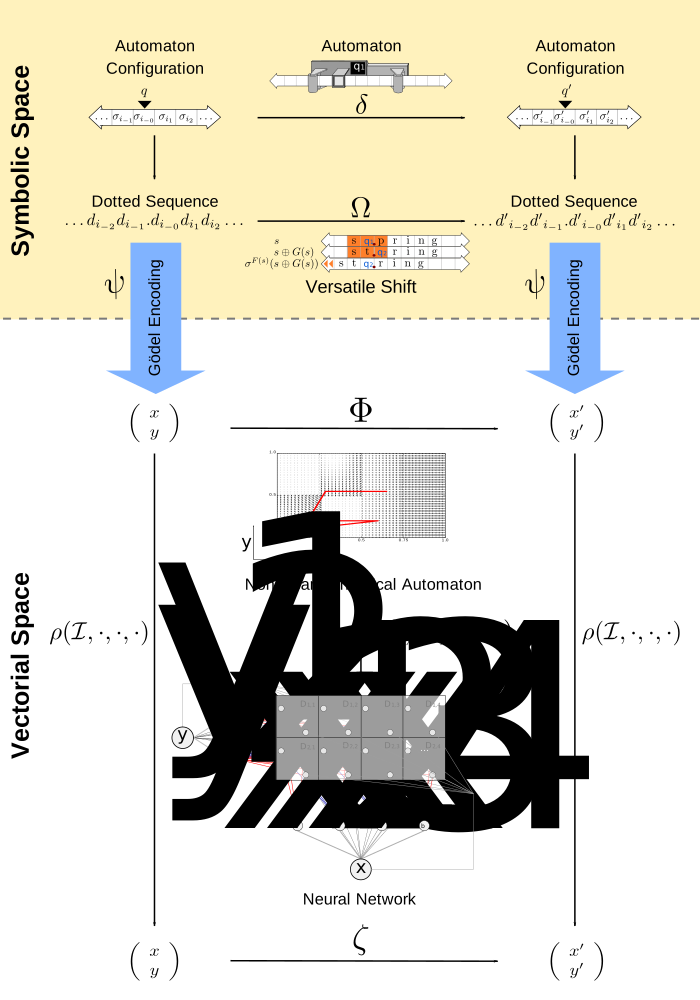
Designed by BCAM in collaboration with EU partners. NA is a novel mathematical-computational modelling framework that allows mapping symbolic computations to biologically plausible neural networks. The resulting network is thus endowed with the ability of executing arbitrary partially computable functions or algorithms. Thus, the framework facilitates the design of parsimonious biologically inspired neuromorphic circuits that execute desired algorithms but also universal computation. A proof-of-concept RTL implementation of an NA engine for image processing is envisaged.
COMPUTATIONAL SRAM (C-SRAM) by CEA-List

Designed by CEA-List. It is a vector co-processor based on a near-memory computing architecture that integrates SRAM memory tightly coupled with a vector processing unit that decodes specific instructions and performs operations on any vector-line of the SRAM. Hence, the C-SRAM can be used both as a programmable vector co-processor and/or as a low-latency SRAM to reduce energy consumption by minimising data movement.
SoC4CRIS Subsystem

Designed by UPV-EHU in collaboration with IKERLAN and other Basque partners. SoC4CRIS is a RISC-V-based scalable and configurable SoC architecture that integrates AMBA-based on-chip communication IP and interfaces for off-chip memory and industrial sensors and transceivers, including Time Sensitive Network (TSN).


Navigation Algorithms by VICOMTECH

Designed by VICOMTECH. Hybrid navigation algorithms integrating CNN models and deep learning models designed for events to leverage the rich temporal information from DVS and the detailed spatial information from frame-based sensors.
SNN Models by TECNALIA

Designed by TECNALIA. Techniques for analysing and characterising the latent activity of SNNs, combined with algorithmic methods to extract insights —such as explainable approaches for detecting out-of-distribution stimuli at the network’s inputs— supporting the implementation of selective visual attention to drive the foveated DVS chip.
BegiBrainTool by BioBizkaia

Designed by BioBizkaia. Computerised modular toolbox combining spatial and dynamic vision assessments with autonomic response measurements to identify visual and physiological markers of major neurodegenerative diseases, such as Alzheimer’s and Parkinson’s.
Hyperspectral DVS by UPV-EHU

UPV-EHU is investigating the technological feasibility and potential of hyperspectral DVS to enhance vision pipelines, targeting Imec’s Fabry-Perot on-chip filters applied to DVS pixels. The research aims to create technology-aware hyperspectral DVS datasets by processing real-world data collected onboard trains and other vehicles with a multisensor setup combining commercial Sony-Prophesee IMX636 DVS, together with NIR and SWIR small size hyperspectral snapshot cameras. Proof-of-concept event-based vision pipelines aimed at object detection and tracking are also being developed to process these datasets effectively.
Selective Attention SNN by Manchester University

Designed by the University of Manchester. A two-layer SNN model with Leaky Integrate-and-Fire (LIF) neurons to process the low-resolution visual input from the EF-DVS to identify proto-objects (i.e., features resembling objects or their parts) using spiking convolution with Von Mises (VM) filters. The first layer detects filter activations, while the second layer combines neighboring kernels with opposite convexity to create a saliency map. A winner-take-all mechanism in the second layer selects the most salient proto-object as the region of interest for high-resolution processing in the EF-DVS.
